
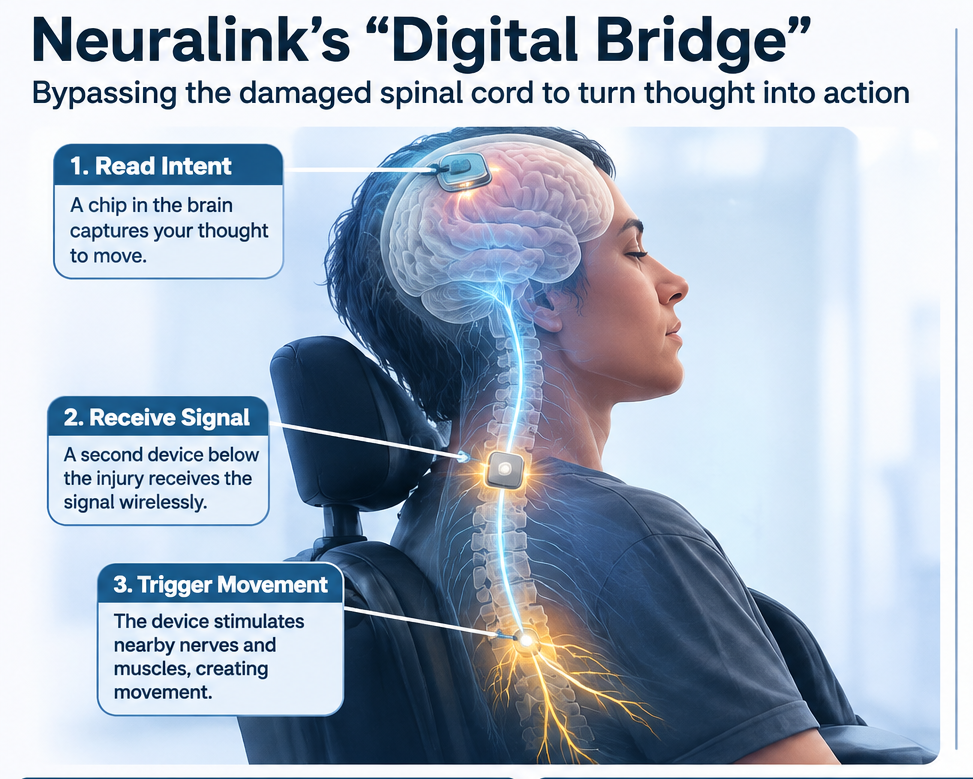
While most spinal cord injury (SCI) research focuses on repairing, stimulating, or retraining the injured pathways in the spine, Elon Musk’s neurotechnology company, Neuralink, is taking a different approach: bypassing the damaged spinal cord entirely.
Rather than treating the injury site itself, Neuralink uses a brain-computer interface (BCI) to read neural signals directly from the motor cortex—the part of the brain that plans and executes movement—and transmit those intentions to external hardware.
What Neuralink Can Do Today
Digital Autonomy Through Thought ("Telepathy"): In the ongoing PRIME Study clinical trials, participants living with quadriplegia from spinal cord injuries have been implanted with the N1 chip. By capturing neural signals when a participant simply thinks about moving, the system allows users to control digital devices wirelessly. Trial participants, including Noland Arbaugh (the first human recipient), use the device for hours daily to navigate computers, write, play video games, and operate software without physical movement.
Direct Control of Physical Hardware: Neuralink has expanded its clinical research through projects like the CONVOY study, connecting the brain chip to assistive robotic arms. Rather than relying on a mouse or screen, participants use thought-based controls to maneuver robotic limbs to perform physical tasks in their environment.
What Neuralink Cannot Do (Yet)
It Does Not Repair Spinal Tissue: Neuralink does not heal the physical spinal cord, restore natural spinal reflexes, or fix damaged nerves. The implant operates higher up in the nervous system, translating brain intent into digital code.
It Is Not a Physical Walking Solution Today: Currently, the technology acts as a bridge to computers, software, and external robotic tools. It does not yet restore organic movement to a person's biological legs or arms.
It Requires Brain Surgery: Unlike surface-level non-invasive therapies, installing the N1 device requires a surgical procedure performed by a specialized robot to insert thin electrode threads directly into brain tissue.
The Ultimate Goal: The "Digital Bridge"
Neuralink’s long-term plan for spinal cord injury is a two-part system designed to bypass damaged neural pathways completely:
Reading Intent: A chip implanted in the brain captures the user's conscious intention to move a limb.
Receiving Signal: A secondary stimulation device implanted below the spinal cord injury site receives that signal wirelessly.
Triggering Movement: The lower spinal device stimulates the local nerves and muscles directly, creating an artificial bypass that turns thought into physical movement.
By shifting the focus from fixing damaged tissue to rerouting communication signals around it, BCI research represents an alternative approach being explored to support physical and digital independence after severe spinal cord injury.
Editor’s Note & Disclaimer: This article is provided for educational and informational purposes only and does not constitute medical advice or an endorsement of Neuralink, its clinical trials, or any specific medical technology. Readers interested in independent clinical trial details or eligibility criteria can review the U.S. National Library of Medicine’s listing at ClinicalTrials.gov (Study NCT06429735) or visit the Neuralink Clinical Trials page. Always consult a qualified healthcare provider regarding treatment options and clinical study participation.
