
The Next Movement in Recovery: Bringing Clinical Walking Therapy Home
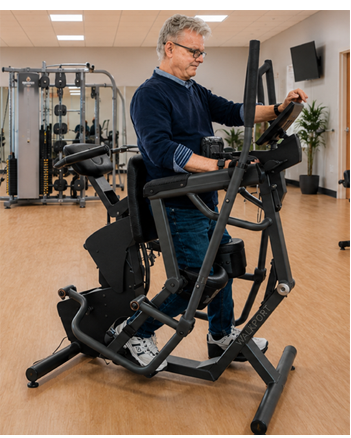
Photo used with permission.
For decades, the spinal cord injury community has looked for ways to transition safely from a seated position to standing. Early engineering breakthroughs in stationary standing frames, such as the widely known EasyStand invented by Alan Tholkes, helped thousands of wheelchair users achieve an upright position for vital weight-bearing benefits. However, while traditional standing frames keep the lower extremities static, a fresh shift in assistive technology is emerging to take individuals from stationary standing to supported, repetitive walking within a home setting. Tholkes and his team at Medthera are addressing this exact transition with their latest development, a home walking station called the WalkPort.
Some of you may remember rehab sessions where you were suspended in a harness over a treadmill while physical therapists manually guided your legs to replicate the rhythm and sensation of walking. While these sessions are highly beneficial, regular visits to advanced clinical facilities are often logistically and financially unsustainable. Because clinical rehab stays are relatively brief, most people return home without a continuous, long-term solution to replicate that locomotor movement. This new device aims to pick up where clinical therapy leaves off, making advanced gait movement accessible outside of the hospital.
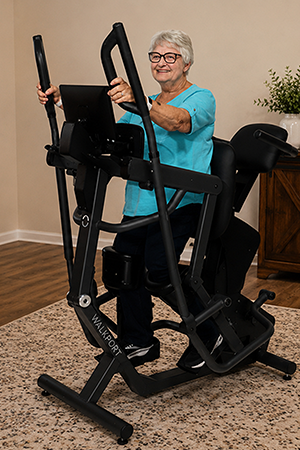
Photo used with permission.
Bringing this type of rehab therapy home, the WalkPort allows a user to transfer from a wheelchair onto a powered seat that gently elevates them into an upright position. Once the device automatically aligns and secures the lower extremities, the user initiates movement. Depending on the level of function, individuals can use their arms to drive the mechanical stepping motion, leverage their own leg strength if they have partial function, or combine both methods. This setup eliminates the need for multiple therapists to manually guide a patient's legs, allowing for safe, independent daily use.
Neurological research consistently shows that the nervous system thrives on high-repetition movement. For individuals navigating an incomplete spinal cord injury, structured, repetitive gait training stimulates neural pathways to help the body maintain and relearn stepping patterns. Beyond neurological benefits, regular upright walking provides critical secondary health advantages, including improving circulation, preserving lower-body bone density, reducing muscle spasms, and providing a psychological boost from seeing the world from an eye-level perspective. To help track these benefits, the system pairs with a dedicated mobile app that logs stand time, walking duration, step count, and cadence in real time.
The WalkPort is scheduled for production beginning in August, 2026. It is available for home purchase starting at $14,995, with devices scheduled to be ready for delivery in October. It is designed to accommodate people between 4'10" and 6'2" with a weight capacity of 250 lbs. Users will need to be able to transfer independently or with minimal assistance and maintain movement in at least one arm. This technology represents a significant shift toward making continuous mobility therapy highly accessible at home. If you’d like to learn more about the technology, you can check out the WalkPort website.
