
Sit-Ins, Stair Crawls, and Zoom Links: The Ongoing Grassroots Battle for True Accessibility
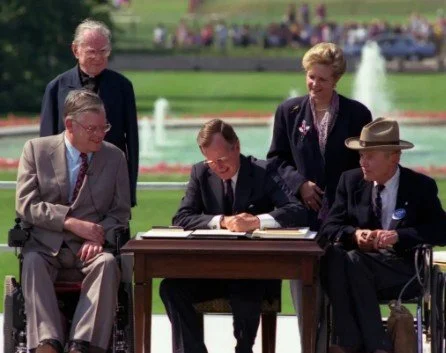
Image Courtesy: https://catalog.archives.gov/
When President George H.W. Bush signed the Americans with Disabilities Act (ADA) on July 26, 1990, it looked like Washington was working with rare, lightning-fast harmony. The bill sailed through Congress with lopsided bipartisan support, appearing to be an easy political win. But the real story behind the ADA isn't about polite political handshakes in sterile committee rooms; it’s a gritty history of raw grassroots strategy and advocates putting their bodies on the line. The foundation was laid back during the historic 1977 HEW (Health, Education, and Welfare buildings) sit-in in San Francisco, where more than 100 activists staged a 25-day occupation of a federal building to force the government to enforce basic disability regulations. That unyielding collective grit eventually culminated in the famous "Capitol Crawl" on March 12, 1990, where advocates cast aside their wheelchairs and mobility aids to drag themselves up all 83 stone steps of the U.S. Capitol, completely shattering corporate opposition and pushing the ADA across the finish line.
The Modern Fight: Roll on Capitol Hill 2026
That legacy of direct action didn't stop in 1990; it just evolved. This June, the modern battleground shifted from the physical steps of the Capitol straight into the digital halls of policy during United Spinal Association's 14th annual Roll on Capitol Hill (ROCH) advocacy event. To maximize community reach and eliminate the financial and physical travel barriers of getting to Washington D.C., this year’s three-day event was held entirely virtually via Zoom. The impact was massive, with over 160 advocates from every corner of the country mobilizing to participate in nearly 200 virtual congressional meetings face-to-face with lawmakers right from their own living rooms.
The stakes were incredibly high this year, with advocates focusing their virtual meetings on three critical independence and healthcare issues. First, they fought to defend Home and Community-Based Services (HCBS), protecting the essential Medicaid infrastructure that allows people with disabilities to live and work in their communities. Second, they pushed for proper insurance coverage for specialized equipment, including customized titanium and carbon fiber wheelchairs, as well as critical catheter and ostomy supplies. Finally, they urged lawmakers to eliminate the frustrating prior authorization hurdles that cause lengthy, unsafe delays when a custom wheelchair breaks down. From the 1977 sit-in to the virtual congressional rooms of ROCH 2026, the message remains exactly the same: true accessibility only happens when our community shows up, speaks out, and demands a seat at the table.
