
Directing the Recovery: Autonomy and Accountability in Airline Mobility Claims
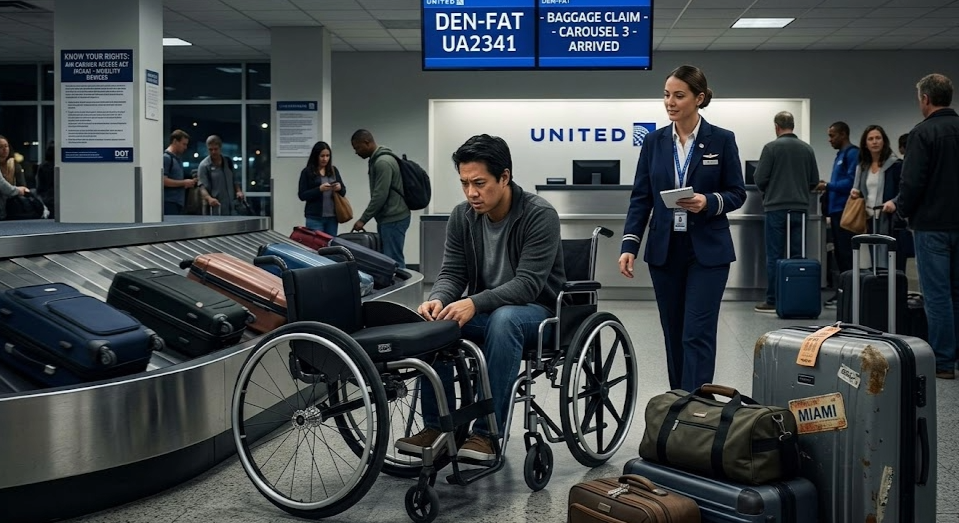
When a mobility device is damaged during a flight, the immediate focus is often on the logistics of repair. However, a recent case involving a traveler flying from Miami to Fresno via Denver highlights a significant evolution in airline accountability: the prioritization of the passenger’s continuous mobility and their right to select trusted local experts for repairs.
Immediate Support and the Safety Net
The transition from a "bad deal" to a managed resolution began at the United Airlines baggage claim in Fresno. Upon identifying that a side guard for a TiLite Aero Z was missing, the traveler was met with a proactive response rather than resistance.
Crucially, the airline and their claim administrator, Scootaround, offered a loaner wheelchair at every major touchpoint—first at the baggage claim and again during subsequent coordination calls. This redundancy in offering a rental ensures that a passenger is never left stranded, acknowledging that for wheelchair users, the device is a fundamental necessity for daily life, not just luggage.
The Power of Vendor Choice
A vital protection under current Department of Transportation (DOT) guidance is the passenger’s ability to direct the repair process. In this instance, the traveler was given the right to select a preferred vendor. By choosing the local Fresno business that originally sold and fitted the Aero Z just last summer, the traveler ensured that the repairs would be handled by professionals who already understand the chair’s specific configuration.
This "vendor of choice" model is essential. It moves the power back to the user, ensuring that replacements—like custom side guards—are ordered accurately and installed by trusted technicians.
The Regulatory Context
This level of service is supported by the Air Carrier Access Act (ACAA) and reinforced by 2025 DOT regulations. These rules explicitly state that airlines must provide functional loaner wheelchairs that meet the passenger’s specific needs and cover all costs associated with transporting the device to a preferred repair facility. Furthermore, mishandling a wheelchair is now classified as a per se violation of federal law, which likely contributes to the swifter, more accommodating responses seen at baggage claims today.
Conclusion: A Standard for the Future
It is still the traveler’s responsibility to report any damage immediately. When a passenger discovers damage upon arrival, it is critical to report the incident immediately at the airport baggage claim, as leaving without documenting the issue may eliminate any legal recourse for repairs. To ensure a smooth claims process, travelers should always take comprehensive, dated photographs of their wheelchair from all angles before releasing it to the airline, providing proof that the device must be returned in the exact same condition—even covering seemingly minor issues like paint scratches.
While equipment damage remains a significant frustration, the efficiency of the response in this case provides a blueprint for traveler rights. When an airline provides immediate help, repeated offers of temporary equipment, and the freedom to use a trusted local vendor, they uphold the dignity and autonomy of the passenger.
