
Where the Dollars Go: Two Related Perspectives on Federal SCI Funding
by, Marco Sorani
There's a lot of discussion about funding for medical research, but have you ever wondered how exactly that funding is allocated?
A recent publication titled "Funding Distributions, Trends, Gaps, and Policy Implications for Spinal Cord Injury Research: A Systematic Analysis of U.S. Federal Funds" helps to answer this question.
For years, tracking how federal dollars flow into spinal cord injury research across major institutions—like the National Institutes of Health (NIH), the Department of Veterans Affairs (VA), and the Department of Defense Congressionally Directed Medical Research Program (CDMRP) Spinal Cord Injury Research Program (SCIRP)—has been opaque.
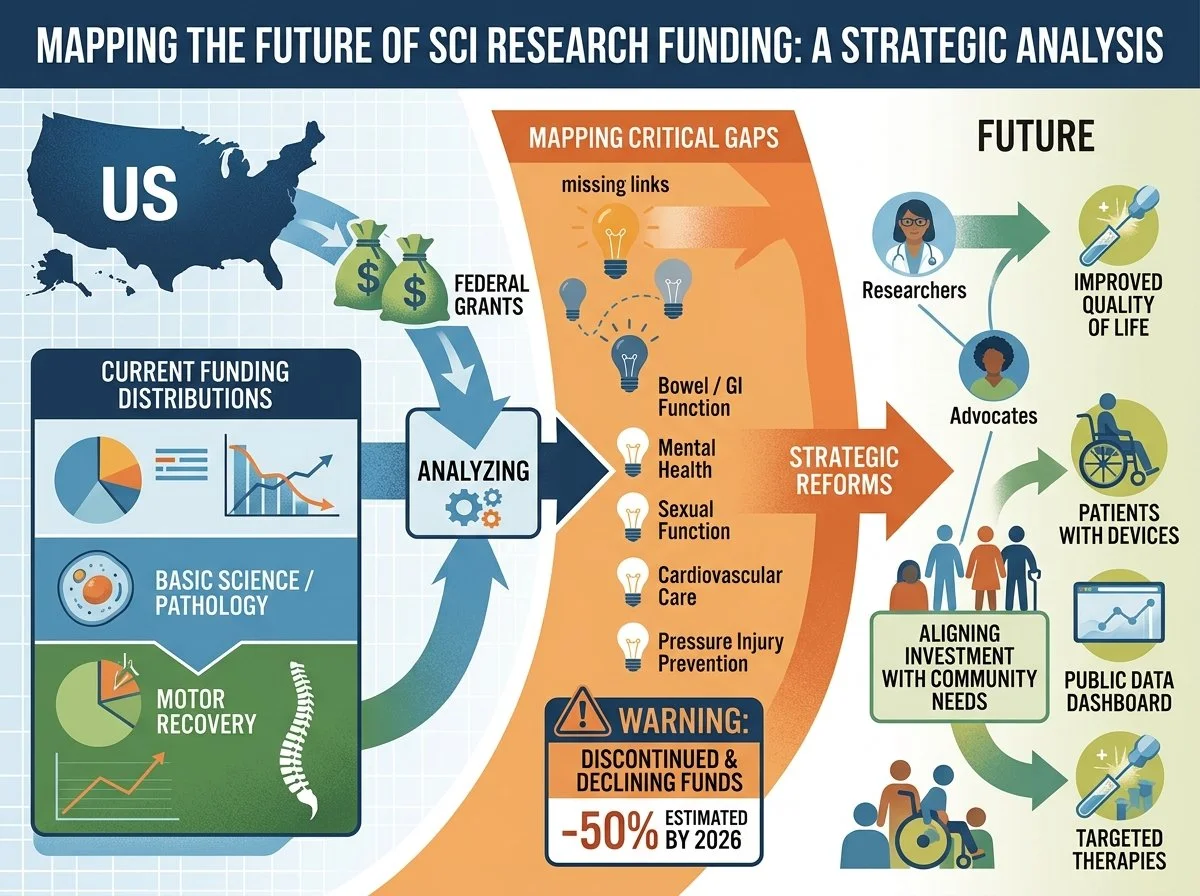
This paper provides the first comprehensive map of federal spinal cord injury funding by analyzing 1,589 federally funded research awards. Here is why these findings are so vital:
Uncovering Critical Gaps: The study reveals that while institutions like the National Institutes of Health heavily concentrate on basic science, pathology, and motor functional recovery, crucial everyday priorities for individuals living with spinal cord injury—such as bowel and gastrointestinal health, cardiovascular function, and mental health—face funding shortages.
Sounding the Alarm on Funding Threats: Thanks to the robust data provided by studies like this and dedicated advocacy from our community, Congress acted to restore funding for the CDMRP Spinal Cord Injury Research Program, keeping this vital resource active.
A Roadmap for Strategic Investment: By proposing a publicly accessible "living dashboard," the authors have created a practical blueprint to enhance transparency, foster interdisciplinary collaboration, and align future research dollars directly with the actual needs of the spinal cord injury community.
Having these findings formally published gives advocates, researchers, and policymakers a rigorous, data-backed foundation to protect and reform the future of spinal cord injury research at a critical crossroads.
Related to the question of how funding is allocated is the question of whether it matches the priorities of the community.
In another recent publication titled "The unmet burden of secondary SCI complications: lost in translation", our Board Member, Marco Sorani has collaborated with Professor Alexander Rabchevsky of the University of Kentucky to argue that federal research investment remains skewed toward locomotor restoration rather than the many secondary complications—bowel and bladder dysfunction, autonomic dysreflexia, pressure injuries, and neuropathic pain—that people with chronic SCI consistently identify as their greatest daily burden.
Sorani and Rabchevsky start by pointing out that spinal cord injury can result in significant disability, yet only receives about 0.2% of NIH funding. In addition, as discussed in the article above, movement/mobility studies draw nearly twice the funding allocated to pain, bladder, bowel, and pressure-injury research combined.
This is a misalignment with past surveys on the functional priorities of people living with SCI. Sorani and Rabchevsky argue that "secondary complications" should be primary research focus areas rather than downstream concerns.
They call on researchers, clinicians, and advocates to realign scientific priorities, clinical training, and policy with the actual burden of chronic SCI.
These articles and meetings with Congress members and the FDA, such as the upcoming Patient-Focused Drug Development (PFDD) meeting for SCI are opportunities to make sure that spinal cord injury research receives appropriate funding and that funding is allocated to the priorities of the community.
