
Preparing for Departure: How Innovative Design is Transforming Accessible Travel
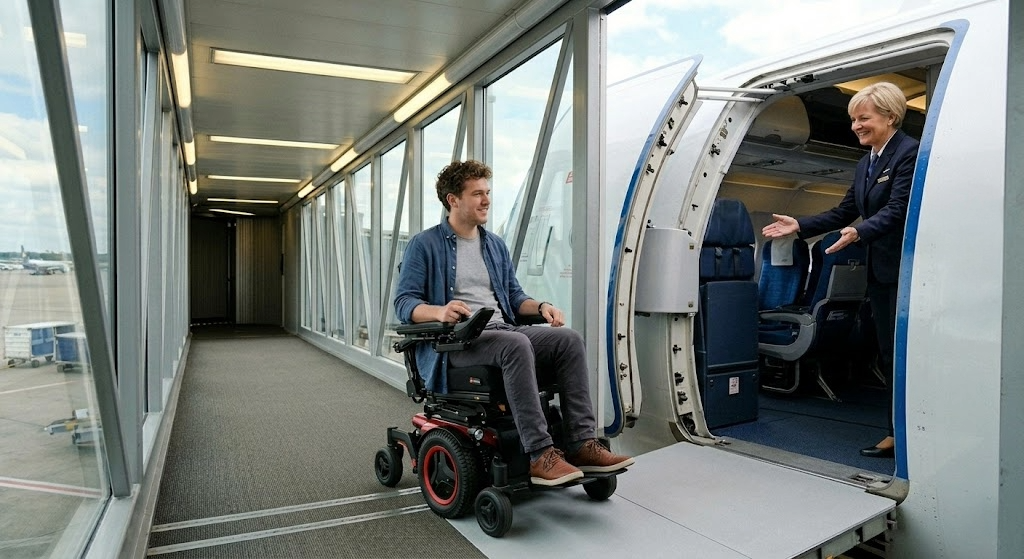
For decades, hopping on a commercial flight has given millions of travelers total freedom, but for people with disabilities, the skies have historically been defined by a lot of friction. In the early days of aviation, accessibility didn't really exist. Passengers who couldn’t walk had to rely entirely on being physically carried up narrow boarding stairs and squeezed into standard seats. Even with modern assistance laws, the actual boarding experience has remained incredibly stressful and exhausting.
The Frustrating Reality of Air Travel Today
That frustrating reality still lands heavily on wheelchair users today. Under standard airport practices, passengers have to give up their personal chairs just before they board the plane so they can be stowed away in the cargo hold. From there, they are forced to transfer into narrow, uncomfortable airport aisle chairs, where they get strapped in tightly and wheeled backward down the aisle to a regular seat. This awkward process feels deeply exposing, and worse, it results in thousands of personal wheelchairs being broken every single year in U.S. airports alone, completely stripping travelers of their independence the moment they land.
It Only Takes a Spark: The Trailblazer Who Lit the Way
Fortunately, a major shift is finally happening, and while a global engineering giant recently made waves with a historic breakthrough, the real momentum traces back to a different trailblazer who lit the touchpaper for the entire industry.
That catalyst is Chris Wood, the founder of the UK advocacy consultancy Flying Disabled and a driving force behind the pioneering Air4All consortium. Working alongside Delta Flight Products, Wood and his team did something historic: they designed a groundbreaking convertible aircraft seat that proved true wheelchair securement in a commercial cabin was actually possible, all without forcing airlines to cut down on their total seat count.
By showing the aviation world that inclusion and engineering could work hand-in-hand, Air4All sparked a massive wave of fresh ideas. This turning point was on full display at the prestigious Crystal Cabin Awards. After launching a first-of-its-kind category dedicated entirely to cabin accessibility in 2025, the competition expanded to feature an incredible 11 distinct entries this year alone. Innovation is no longer just happening in one design studio—it has become a global race to redefine the future of travel.
Airbus Steps Up with Real-World Flight Tests
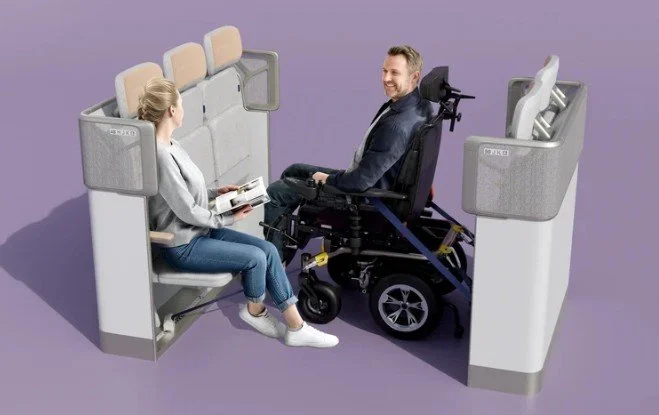
Image Courtesy of AIRBUS
Among those major new entries is aerospace giant Airbus, which recently turned heads by moving accessibility from a digital rendering into actual reality. Their brand-new cabin innovation, known as the Airspace U Suite, took a historic leap forward during a real-world flight test on an Airbus A350 test aircraft. For the first time in aviation history, a passenger with reduced mobility—Airbus design engineer Dirk Thalheim—remained securely in his own personal power wheelchair during the cruise phase of a real flight.
The brilliance of the Airbus U Suite lies in its flexibility. Rather than creating a segregated, "special" zone, Airbus designed a modular, multi-purpose space. When a wheelchair user is on board, the space anchors the chair directly to the cabin floor tracks with a specialized restraint system. When it isn't being used for a wheelchair, the exact same footprint can transform into a lie-flat bed for long-haul passengers, a shared family seating zone, or a co-working booth for business travelers. This smart versatility makes it highly appealing for commercial airlines to adopt, directly complementing the path that Air4All cleared.
Navigating the Regulatory Runway
But bringing these designs from the exhibition floor to everyday commercial flights means navigating complex regulatory systems, which is where the next phase of the journey begins. While the Air4All team continues to push forward alongside Delta Flight Products, progress on U.S. certification has taken a more deliberate pace. Under former Transportation Secretary Pete Buttigieg, fast-tracking tight wheelchair protections was a front-and-center priority. The current administration is approaching the runway through a different lens, focusing on a cautious, steady evaluation to balance new enforcement with existing domestic airport infrastructure.
Charting a Global Path Forward
Rather than waiting for the winds to change, Wood and the Air4All consortium are proactively charting a new path forward. To keep the momentum alive, they are currently exploring options to process their engineering approvals and certifications directly through regulatory bodies in the UK and Europe. Meanwhile, Airbus is targeting 2032 for its own suite's entry into service, using the intervening years to carefully build out the brand-new safety standards required for commercial rollout.
Thanks to the trail blazed by Air4All and the massive engineering weight now being thrown around by giants like Airbus, the conversation around flying has permanently changed. By looking beyond current boundaries and pushing for global partnerships, advocates and engineers are ensuring that the march toward an inclusive cabin never stops. The future of flight is being rewritten, and soon everyone will be “free to move about the cabin”.
